
A household can send fewer disposable diapers to the trash and still use more electricity for laundry. Both outcomes matter, and they answer different questions. The environmental benefits of cloth baby diapers are easiest to understand when you compare the same period of diapering and separate waste, greenhouse gas emissions, and water use. Reuse determines how many disposables you replace. Materials, manufacturing, and the way you wash and dry cloth determine much of the rest. Start with your actual routine, including days when you use disposables, and use a life-cycle study to understand which parts of that routine can change the result.
How Cloth Diapers Reduce Waste
Each successful cloth change replaces one disposable change if that is what you would otherwise have used. The waste advantage builds through repetition. A cloth diaper or insert eventually reaches the end of its useful life, but it can provide many changes before that happens. What matters for the household is the number of times it gets used, not simply the number of pieces purchased.
Consider an illustrative week with 42 diaper changes. If the household uses disposables for every change, it uses 42 disposable diapers. If it uses cloth for 24 changes and disposables for the other 18, it avoids 24 disposable diapers that week relative to the all-disposable routine. If it uses cloth for all 42, it avoids 42. These are arithmetic examples, not estimates of a typical baby’s needs. For your own comparison, count actual changes and repeat the count when your routine changes.
| Illustrative routine | Cloth changes | Disposable changes | Disposables avoided |
|---|---|---|---|
| All disposable | 0 | 42 | 0 |
| Cloth at home with some disposable use | 24 | 18 | 24 |
| All cloth | 42 | 0 | 42 |
Keep disposable liners in a separate column if you use them. A cloth change with a single-use liner still replaces a disposable diaper, but it also creates liner waste. The same principle applies to the worn cloth products themselves. A count of avoided disposable diapers describes one waste stream. A full waste comparison would also account for discarded cloth components, liners, and packaging.
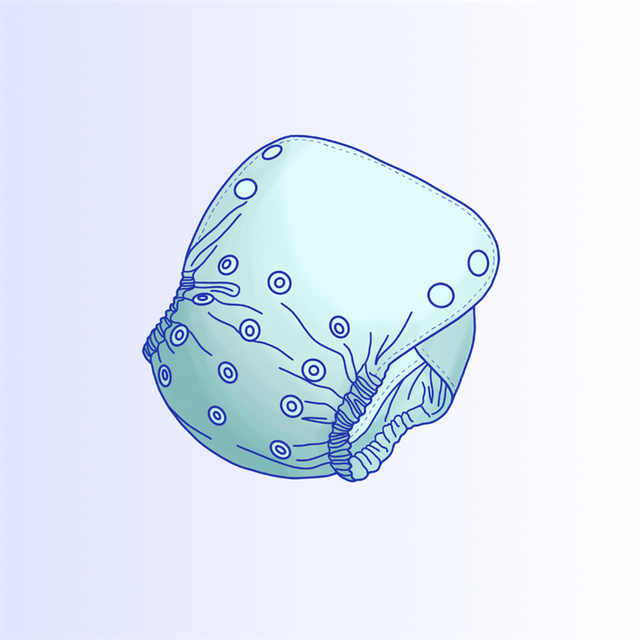
The construction of the diaper can affect what you replace. Some Reusable Baby Diapers use separate covers and absorbent inserts. If the product’s instructions and its condition allow a cover to be used again, only the absorbent part needs replacing at that change. In an all-in-one design the whole unit generally goes into the wash after use. Both can replace disposables. The practical advantage of a system depends on what gets washed, how quickly the parts dry, and whether the design fits the household’s routine.
A mixed routine can make its biggest contribution where it is easiest to maintain. If cloth works on days at home and the daycare requires disposables, count those at-home cloth changes. If travel interrupts the routine, update the count when you return. A realistic estimate based on changes you actually make is more informative than a number that assumes full-time use.

When Do Cloth Diapers Have a Lower Carbon Footprint?
A life-cycle assessment compares the greenhouse gas emissions associated with providing a diapering service. That includes materials, production, distribution, use, and disposal. Use the same period and comparable diapering needs for both systems. A single disposable diaper and a single cloth diaper provide very different numbers of changes, so comparing the emissions of one item against one item leaves out how each product is used.
A UK assessment commissioned by Defra modeled diapering for one child over two and a half years. In its baseline, the modeled global warming potential was approximately 345 kg CO₂e for reusable nappies and 457 kg CO₂e for disposables. The reusable result included home laundering. The figures describe two modeled UK systems over that period. They depend on the products, laundry assumptions, electricity supply, and waste pathways used in the assessment.
The emissions also came from different places. For cloth, the study attributed most baseline emissions to the use phase, which included washing and drying. For disposables, manufacturing and the supply of materials are important because a new item is needed for each change. This difference explains why a household has more influence over the laundry portion of the cloth diaper footprint than over the factory portion of a disposable diaper footprint.
| Cloth diaper routine | Where the carbon footprint can change | What to compare |
|---|---|---|
| Mostly air-dried | Less energy is used for powered drying | Which components you can air-dry and how often you actually do so |
| Often tumble-dried | Drying adds electricity use | How many loads you dry, how full they are, and which dryer is used |
| The same set is used for another child | Production is spread over more uses | How many pieces can be reused and how many require replacement |
A dryer model and the local electricity mix matter alongside frequency. Two homes that tumble-dry the same number of loads can have different emissions. A home that normally line-dries but relies on a dryer in winter should account for both seasons. A comparison becomes more representative when it reflects the whole routine instead of the best week of the year.
Second-child reuse works through a separate mechanism. Laundering still happens, but fewer new pieces are required to provide the next set of changes. The reduction depends on what actually carries over. If only the covers last and the inserts need replacement, count the covers reused and the inserts purchased. The Defra assessment modeled lower global warming potential for a second-child reuse scenario, but that result belongs to the inventory and assumptions it examined.
Read any advertised carbon percentage with three questions in mind. What is the comparison period? Which laundry and energy assumptions are included? Does the claim describe an industry study or the specific product? The UK study can explain where the emissions come from. A claim about a particular diaper model would require evidence for that model and a defined comparison.
Do Cloth Diapers Use More Water Than Disposables?
There are two obvious places to start counting water. For disposables, water is used in the supply of raw materials and in manufacturing. For cloth, production also uses water, and the household uses more during laundering. A comparison that counts the washing machine but skips manufacturing misses one part of the system. A comparison that counts only production misses repeated washing.
What the number represents matters too. Washing machine water describes a household input. A life-cycle water measure can include activities well upstream of that household and may also reflect the way a study defines consumption. Water scarcity adds local context. The same volume of water can have different implications in places with different water availability. A result for one country or supply chain does not automatically carry over to another.
The useful household questions are straightforward. Are diapers being washed in frequent small loads? Are extra rinses needed every time, or only under particular conditions? Can compatible items share a load while following the diaper’s care instructions? Laundry volume and the equipment used both influence the answer. Always use a routine that cleans the diapers properly and complies with their care directions.
Separate environmental and household questions. If you want to understand your water bill, start with the number of laundry cycles and the machine’s cycle specifications. If you want to compare diaper systems environmentally, use a study that includes materials, production, laundering, and disposal for both. Those are different calculations with different boundaries.
How to Make Cloth Diapering More Sustainable
Build around the changes you can repeat
Start with the portion of the week where cloth fits your life. That might be daytime at home, weekends, or all changes except at daycare. Use your own change count to decide how much stock you need. Extra pieces are useful when they support a workable wash cycle or cover slow drying. Buying far beyond what you use increases the amount of material purchased without adding more cloth changes.
Plan laundry around cleaning and drying
Use the manufacturer’s wash directions and your machine’s load guidance. Where practical, run appropriately sized loads and air-dry the pieces that can dry fully in the space available. Track the component that takes longest to dry. A thick insert may need longer than a cover, and that difference can affect both how much you buy and how often you use powered drying.
Adjust the plan to your home. In a humid season, you may be able to air-dry covers and use the dryer for suitable inserts. In a small apartment, the amount of drying space may set the limit on how many changes you can handle with cloth. A mixed routine can still replace disposables while staying within those constraints.
Keep useful components in circulation
Inspect parts before replacing a whole set. A modular system can make it possible to retain useful covers while replacing inserts that no longer work for your needs, provided the pieces are compatible and in suitable condition. If the diapers will be passed to another child, inspect the fasteners, elastics, absorbent components, and any waterproof backing before putting the set back into service.
To see how your routine changes over time, keep a short record of three items: cloth changes, diaper laundry loads, and dryer loads. Repeat it for a representative week in another season. You will see whether the routine still replaces the number of disposables you expected and which laundry habits have the most room to change.
Choose a routine you can sustain
The environmental benefits of cloth baby diapers depend on how many changes the products provide and what it takes to prepare them for the next use. Count the disposables you actually replace, then look at laundry and drying separately. Kingsoo manufactures reusable baby diapers in multiple constructions, so consider which components your chosen design sends to the wash and which can stay in service. A system that fits your laundry space and survives repeated use gives you a clearer basis for comparing waste, carbon, and water over time.
Frequently asked questions
- Do cloth baby diapers still reduce waste if daycare uses disposables?
-
Yes. Count the cloth changes you make outside daycare against the disposables you would have used for those changes. Your reduction will reflect that portion of the routine.
- Does a cloth diaper laundry service change the carbon comparison?
-
It can. The service’s equipment, drying method, load sizes, and transport are part of the comparison. A home-laundry study may not describe that setup.
- Can compostable disposable diapers go in a home compost bin?
-
Check the product instructions and local acceptance rules before choosing a disposal route. A product intended for an industrial facility may require a collection service and a facility that specifically accepts used diapers.
- Does buying more cloth diapers improve the environmental outcome?
-
Extra stock can help when drying is slow or it allows a more practical laundry schedule. Its value depends on whether the extra pieces actually get used and replace disposable changes.


