- All
- Product Name
- Product Keyword
- Product Model
- Product Summary
- Product Description
- Multi Field Search
English

Author: Site Editor Publish Time: 2026-04-08 Origin: Site
Many parents ask the same question: are cloth diapers really greener than every disposable Baby Diaper option? The answer depends on waste, water use, plastic pollution, and carbon footprint. In this guide, you will learn where cloth diapers help most, what limits their impact, and how to build a more sustainable routine.
In most cases, cloth baby diapers are the more sustainable option, but the environmental advantage depends on how families actually use them. Their biggest strength is that a small reusable stash can cover years of diapering, which sharply reduces single-use waste. That said, cloth is not impact-free: washing, drying, and material choice all shape the final footprint. A realistic answer is this: cloth diapers usually perform better over the full diapering period, especially when they are reused, washed efficiently, and not overbought.
Environmental factor | Disposable baby diapers | Cloth baby diapers |
Waste volume | Thousands discarded per child | Small reusable stash |
Main environmental pressure | Landfill waste, plastics, ongoing production | Water, energy, laundering |
Best-case outcome | Convenience with high waste | Lower overall footprint with efficient use |
Disposable baby diapers create a larger waste burden because they are designed to be used once and thrown away immediately. Over the years before potty training, that adds up to thousands of individual items sent to landfill. The problem is not only volume. Most disposable diapers combine plastic-based layers, absorbent chemicals, adhesives, and packaging, so they persist for a very long time after disposal. Their environmental cost also starts long before the trash bin, since new raw materials, manufacturing, and transport are required again and again for every diaper change.
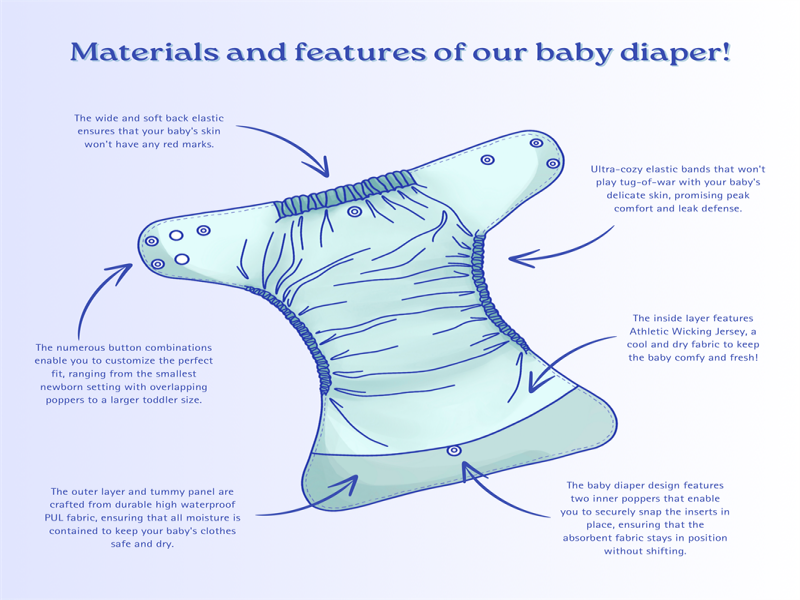
Cloth diapers gain their edge by reducing the need for constant replacement. Instead of relying on a continuous stream of new products, families use the same core set repeatedly, spreading the production impact across many wears. That is why cloth is best described as a lower-waste system, not a zero-impact one. Its environmental benefits become stronger when parents keep the system practical and long-lasting, such as by:
● reusing diapers for another child
● line drying when possible
● choosing durable materials over disposable convenience
● treating part-time cloth use as meaningful progress, not failure
The clearest environmental benefit of cloth diapers is simple: they prevent a large stream of single-use waste from being created in the first place. A disposable diaper system sends thousands of used items to landfill during the diapering years, while a cloth system relies on a much smaller number of products that stay in use for far longer. That difference matters because end-of-life waste is one of the heaviest environmental burdens tied to baby diaper use. Cloth diapers do not eliminate waste entirely, but they shrink it dramatically by replacing repeated disposal with repeated use. For parents comparing options, this is usually the strongest sustainability argument in favor of cloth because it addresses the most visible and persistent environmental problem directly.
Disposable diapers also carry a hidden environmental cost before they are ever thrown away. Because they are made for one-time use, they require constant cycles of raw material extraction, manufacturing, packaging, shipping, retail distribution, and replacement. Cloth diapers work differently. A family buys a core stash once and uses it again and again, which reduces dependence on nonstop new production over the full diapering period. That shift from continuous replacement to repeated use is what gives cloth its resource-efficiency advantage.
Lifecycle pattern | Disposable diapers | Cloth diapers |
Production model | Continuous manufacturing of new units | One smaller stash used repeatedly |
Packaging and transport demand | Ongoing across every purchase cycle | Lower over time after initial purchase |
End-of-life flow | Constant stream of discarded products | Delayed disposal after long use |
Overall system logic | Replace and discard | Reuse and extend lifespan |
Cloth diapers usually start with a higher upfront production footprint per item because they are built to survive repeated wear, washing, and reuse. On a single-item basis, that can make them seem less efficient at first glance. The more useful comparison, however, is not one cloth diaper versus one disposable diaper, but one full diapering period versus another. When the same cloth diapers are used hundreds of times, the original production impact is spread across many changes instead of being attached to only one use. That is why cloth often shows a lower carbon footprint over time: the product lasts long enough to dilute its initial environmental cost, while disposable diapers keep restarting the footprint with every change.
Longer product life makes cloth diapers more efficient with every extra stage of use. Their sustainability improves further when families think in terms of lifecycle extension rather than one-child ownership. The environmental value grows when diapers are:
● reused for younger siblings
● passed to another family secondhand
● repaired instead of replaced early
● kept in circulation long enough to maximize their original manufacturing impact
The biggest ongoing source of emissions in a cloth diaper system usually comes from laundering, not from the diaper sitting on a shelf. That is why two families using the same cloth baby diapers can end up with very different environmental outcomes. Full loads generally perform better than frequent small washes because they spread water and energy use across more items. Wash temperature matters too: routine hot cycles tend to raise energy demand, while warm or cold settings can reduce it when they still clean effectively. Drying choices also make a visible difference. Machine drying adds energy use every time, whereas line drying lowers the carbon burden and can also help extend diaper life.
Laundry factor | Lower-impact approach | Higher-impact approach |
Load size | Full or near-full loads | Frequent small loads |
Wash frequency | Planned routine with fewer extra cycles | Overwashing or repeated rinse-heavy routines |
Water temperature | Cold or warm when effective | Habitual hot washing |
Drying method | Line drying when possible | Regular machine drying |
Fabric choice also changes the real footprint of cloth diapers. Natural-fiber options can be stronger from an end-of-life perspective because they are less tied to plastic-based inputs and may break down more cleanly over time. Synthetic-heavy diapers, by contrast, can raise environmental concerns even when they are durable, since they rely more on petroleum-derived materials and may shed microfibers during repeated washing. At the same time, durability still matters. A diaper that wears out too quickly may need replacement sooner, which weakens its sustainability value. The most responsible material choice is usually one that balances long service life with lower plastic content and fewer disposal concerns.
Cloth diapers are often described as reusable, but reusability only pays off when the products are actually used enough times. Buying far more diapers than a family needs increases the production footprint without creating matching environmental value. A practical stash is usually more sustainable than a large collection built around convenience, impulse buying, or style variation. In environmental terms, unused or lightly used diapers represent wasted manufacturing input, packaging, and transport. Cloth performs best when families treat it as a working system rather than a product category to overconsume.
The greenest diapering option is not identical in every household. Local realities can shift the balance, which is why blanket claims about sustainability often sound stronger than the evidence really supports. Cloth diapers may be less practical or less efficient in places where water scarcity is severe, home laundry access is limited, or electricity use is unusually carbon-intensive. In those situations, the environmental advantage may shrink, especially if cloth requires repeated hot washes and machine drying. Parents evaluating footprint honestly should look at context, including:
● local water stress
● access to efficient washers
● drying conditions indoors or outdoors
● household energy costs and energy mix
A lower-impact baby diaper routine begins with a setup that fits real life, not an idealized version of parenting. Many families make cloth diapering harder than it needs to be by assuming they must switch all at once or buy a large stash immediately. A more sustainable approach is to start with a manageable number of diapers, test what works, and build a routine that can be maintained consistently. This reduces unnecessary purchases and makes it more likely that the diapers will be used often enough to deliver real environmental value. In practice, a simple, repeatable system usually does more for sustainability than an ambitious plan that becomes frustrating after a few weeks.
The most effective wash routine is usually the one that stays efficient without becoming complicated. Parents do not need an elaborate process to keep cloth diapers functional; they need a routine that avoids wasted water, extra detergent, and repeated drying cycles. Fewer unnecessary steps also make cloth easier to continue long term, which matters just as much as any single eco-friendly choice.
Routine choice | Lower-impact habit |
Wash timing | Wait for a solid load instead of washing too often |
Cycle design | Keep the routine straightforward and avoid extra rinse-heavy steps |
Drying | Air dry regularly when weather and space allow |
Product use | Choose a detergent that cleans well without overuse |
Part-time cloth diapering is still a meaningful way to cut the footprint of a baby diaper routine. Families do not need to choose between all cloth and all disposable for their efforts to matter. Using cloth at home, during daytime hours, or only on certain days of the week can still reduce the total number of single-use diapers going to landfill. This approach is especially helpful for households balancing childcare rules, travel, limited laundry access, or postpartum recovery.
A practical hybrid routine often looks like this:
● cloth diapers at home and disposables while out
● cloth during the day and disposables overnight
● cloth on weekends or non-daycare days
● gradual expansion after parents gain confidence with washing and fit
Cloth diapers are generally the more sustainable choice. They reduce landfill waste and lifecycle emissions when families buy carefully, wash efficiently, and reuse them longer. Even part-time use can lower a household’s Baby Diaper footprint. KINGSOO adds value with durable cloth diaper products and practical service support for a simpler, lower-impact routine.
A: A cloth Baby Diaper is usually more sustainable when reused, washed efficiently, and line dried often.
A: A Baby Diaper system’s footprint depends mainly on laundering, material choice, and product lifespan.
A: Cloth Baby Diaper performance drops with overbuying, hot frequent washes, and carbon-intensive drying.


