- All
- Product Name
- Product Keyword
- Product Model
- Product Summary
- Product Description
- Multi Field Search
English

Author: Site Editor Publish Time: 2026-07-23 Origin: Site
Choosing a Pet Diaper by appearance alone can hide the material decisions that determine comfort, absorbency, leakage control, and durability. A soft exterior may still perform poorly if the lining holds moisture against the skin, the core saturates too quickly, or the waterproof layer cracks after washing. The useful question is not which single fabric is “best,” but how several materials work together as one system. The sections below explain the common layers in reusable and disposable designs, their trade-offs, and how to match them to a dog’s needs and care routine.
A Pet Diaper normally combines several components because no single material can provide softness, rapid liquid transfer, high retention, waterproofing, stretch, and secure fastening at the same time. The layer nearest the dog should manage skin contact and move moisture inward. An absorbent core then captures and retains the liquid, while a barrier prevents it from reaching furniture, flooring, or bedding. Elastic sections and adjustable fasteners keep these functional layers positioned correctly as the dog walks, sits, or lies down. Comparable absorbent hygiene products use this same functional sequence of topsheet, acquisition layer, core, backsheet, and fastening components.
Performance depends on the balance between these layers. A highly absorbent core can still leak if the outer barrier is damaged, while a waterproof shell cannot compensate for insufficient capacity or gaps around the body. Excessive thickness may also distort the fit, especially around a small dog’s waist or a male dog’s midsection. Well-designed Reusable Pet Diapers therefore combine a moisture-managing lining, an absorbent center, a waterproof laminate, elastic shaping, and an adjustable closure rather than relying on one heavy fabric. Male wraps and female full-coverage designs use similar material functions but arrange them around different anatomical areas.
The inner lining touches the coat and the sensitive skin around the belly, groin, or hindquarters. Polyester wicking jersey, microfleece, soft knitted polyester, and nonwoven fabrics are frequently selected because they can transfer liquid toward the core without becoming excessively heavy. A smooth surface also reduces friction as the dog moves. However, “breathable” should not be judged from the lining alone. Airflow and heat management are affected by the coating, core thickness, garment coverage, fit, and the length of time the Pet Diaper remains in use.
Natural and regenerated fibers may also appear in washable designs. Cotton terry is soft and absorbent, while bamboo-viscose blends can provide a smooth hand feel and useful fluid uptake. These materials absorb moisture rather than simply passing it through, so the surface may feel damp sooner when the core approaches saturation. Microfiber offers fast absorption and relatively low bulk, but it is usually enclosed between softer layers rather than placed directly against sensitive skin. Material composition must therefore be evaluated together with fabric structure, thickness, finishing, and the location of each layer.
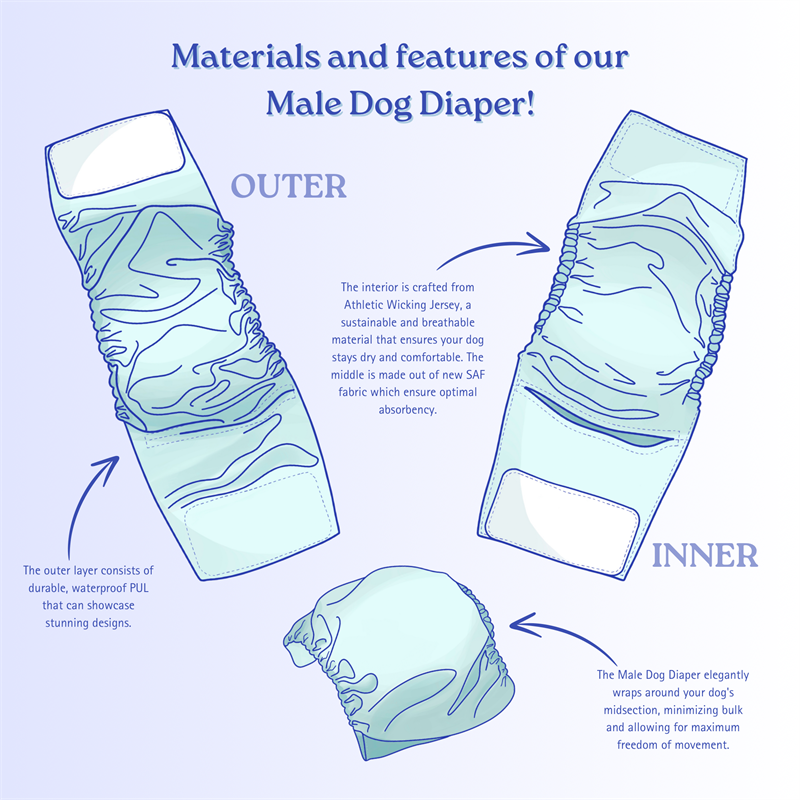
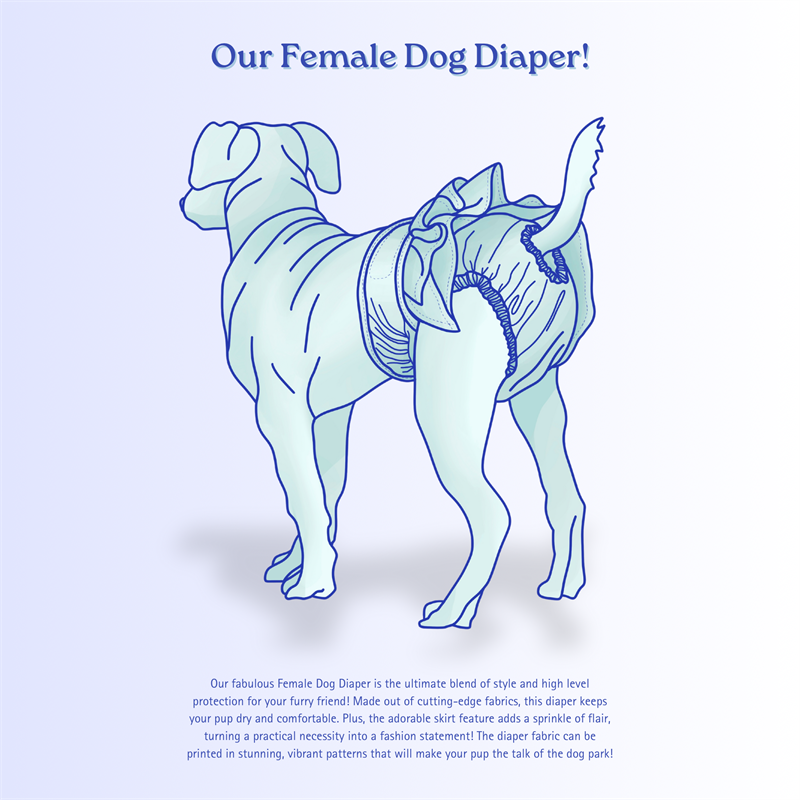
Kingsoo’s reusable male design uses a 100% polyester athletic wicking jersey lining, a super-absorbent middle fabric, and a polyester interlock outer layer laminated with waterproof TPU. Its female design also combines recycled polyester wicking fabric, an absorbent center, and a recycled polyester interlock laminate with TPU. These constructions illustrate how the same fiber family can perform different jobs when it is knitted, finished, or laminated differently.
The absorbent core determines how much liquid the Pet Diaper can manage before it must be changed. Reusable cores may use microfiber, cotton terry, bamboo blends, polyester absorbent fabrics, or combinations of several textiles. Multiple thin layers often distribute moisture more evenly than one bulky pad, but adding layers increases thickness and can interfere with body contouring. The appropriate construction therefore depends on expected volume, frequency of urination, garment size, and whether the product is intended for occasional marking, heat-cycle discharge, puppy accidents, or ongoing incontinence.
Washable core materials retain liquid inside their fiber structure and between fibers. Their practical capacity depends on fabric weight, surface area, compression, stitching, and the number of layers. Pressure from sitting or lying down can expose weaknesses that are not obvious during a simple pour test. Buyers should consequently evaluate absorption speed, retention under pressure, leakage at seams, drying time, and performance after repeated washing. A Pet Diaper intended for frequent daily use should also be tested after laundering because detergent buildup or damaged fibers can change how quickly the core accepts moisture.
Disposable products normally use a different absorbent system. A soft nonwoven topsheet transfers liquid to an acquisition or distribution layer, followed by a core containing cellulose fluff pulp, superabsorbent polymer, or both. SAP particles absorb aqueous liquid and form a gel-like structure that retains moisture even under pressure. A core wrap holds the absorbent material in place, while a film or cloth-like backsheet blocks strike-through. This system can provide high capacity without the laundering requirements of textile cores, although it creates a single-use product.
Material | Typical Role | Main Selection Consideration |
|---|---|---|
Wicking polyester | Skin-contact lining | Transfers moisture with low bulk |
Cotton terry | Reusable absorption | Soft but may remain damp |
Bamboo-viscose blend | Lining or absorbent layer | Feel and performance vary by construction |
Microfiber | Reusable absorbent core | Fast uptake but needs suitable enclosure |
Fluff pulp | Disposable core structure | Distributes liquid and supports SAP |
Superabsorbent polymer | Disposable liquid retention | High capacity and retention under pressure |
The waterproof barrier is commonly made from TPU, PUL, or polyethylene film. TPU is a thermoplastic polyurethane that can be laminated to polyester fabric, producing a flexible, washable barrier with a textile-like exterior. PUL generally describes a fabric laminated with polyurethane and is widely used where waterproofing must remain flexible. Disposable Pet Diaper designs often use thin polyethylene-based films, sometimes covered by nonwoven material to create a softer exterior. Barrier performance depends on film thickness, lamination quality, seam placement, stretch recovery, and resistance to repeated bending—not simply whether “waterproof” appears in the description.
Kingsoo’s male construction specifies a PFC-free TPU coating on polyester interlock, while its female construction uses a recycled polyester interlock laminate with TPU. In both cases, the laminate provides the outer leakage barrier while the inner fabric and core manage moisture. A barrier should remain flexible enough to follow the dog’s body, because a stiff shell can pull away from the waist or legs and create leakage channels. It should also be protected from punctures, excessive heat, aggressive bleaching, and unsuitable care methods that may weaken the coating.
Fastening and elastic materials are equally important. Hook-and-loop tape commonly uses polyester or nylon components and permits repeated waist adjustment, while snaps may be made from resin or metal. Elastane, spandex, rubber, or covered elastic can be positioned around the waist, tail opening, or leg edges to reduce gaps. These materials must stretch without creating concentrated pressure or chafing. Rounded closure corners, smooth edge binding, stable stitching, and protected elastic improve comfort and durability. For washable designs, securing hook-and-loop tabs before laundering and avoiding care products that damage absorbent fabrics or waterproof coatings can help preserve performance.
Material selection should begin with the location and volume of the fluid. A male wrap primarily covers the urinary area around the midsection, so it benefits from a concentrated absorbent zone, a flexible waterproof outer layer, and enough closure adjustment to prevent rotation. Kingsoo’s Male Dog Diaper combines a wicking polyester lining, reusable absorbent fabric, TPU-laminated polyester, elastic shaping, and hook-and-loop fastening. This configuration is intended for applications such as marking management, puppy training, travel, and urinary incontinence.
A female full-coverage design must protect a broader rear area and maintain alignment around the tail and hind legs. The absorbent material should extend across the likely fluid zone without making the garment too bulky. Kingsoo’s Female Dog Diapers use an absorbent center, waterproof exterior, adjustable waist panels, elasticized edges, and a female-specific tail opening. This type of Pet Diaper can be used for heat-cycle management, training accidents, and incontinence, but a correct waist and body-length fit remains essential to keep the core in position.
The dog’s care routine should guide the final choice. Frequent laundering favors materials that dry efficiently, retain their shape, and maintain waterproof integrity. Heavy fluid loads require greater core capacity, but additional thickness should not prevent natural movement or create gaps. Sensitive skin calls for smooth contact surfaces, careful detergent rinsing, regular changes, and time without the garment when practical. A Pet Diaper should also be replaced promptly when saturated or soiled rather than treated as an extended-wear containment system.
For procurement or product evaluation, request a complete layer description rather than one general fabric name. Check the fiber composition of the lining, the type and weight of the absorbent core, the barrier material, closure construction, elastic recovery, seam protection, and recommended wash temperature. Examine samples after repeated fastening, stretching, washing, and drying. Watch for delamination, shrinkage, surface pilling, slow absorption, odor retention, weakened hook-and-loop grip, and leakage under pressure. New or unexplained urinary incontinence should still receive veterinary assessment because a Pet Diaper manages the resulting moisture but does not identify or treat the underlying cause.
A dependable Pet Diaper is a system, not a single fabric. The lining should move moisture away from the body, the core must match the expected fluid load, the barrier should resist leakage without excessive stiffness, and the closures must maintain a secure fit through movement and care. Material labels are most useful when they explain each layer’s function, composition, and wash limits. As a Pet Diaper manufacturer and supplier with documented production lines and quality-control steps, Kingsoo develops reusable designs that combine wicking polyester, absorbent cores, waterproof TPU laminates, elastic shaping, and adjustable fasteners.
A: No single material is most important. Reliable performance requires a compatible lining, absorbent core, waterproof barrier, elastic structure, and secure closure system.
A: Both can provide flexible waterproofing. Performance depends on film thickness, lamination quality, stretch, seam construction, wash resistance, and how the barrier is positioned.
A: Not necessarily. Fiber type matters, but surface texture, retained moisture, detergent residue, fit, changing frequency, and individual skin sensitivity can be equally important.
A: Many include polymer-based nonwoven layers, superabsorbent polymer, elastic components, adhesives, and a film backsheet, although the exact composition varies among designs.
A: Review its wash instructions and test samples for shrinking, delamination, damaged elastic, weakened fasteners, slower absorption, surface wear, and leakage after repeated laundering.